Daily Workout
A structured 30-minute session so a student never has to decide what to practice; they just start.
Auctor RC tracks what a student gets wrong, why they get it wrong, and adjusts future practice around that specific gap.
Built from classroom experience
Auctor Labs is an ed-tech company building AI training tools for competitive exam prep in India. The first product is Auctor RC, focused on Reading Comprehension. The company was founded by Neeraj sir, who has taught competitive exam students for 15-plus years.
The starting problem was simple. Most RC prep is the same worksheet model that has existed for twenty years: solve a passage, check the answer key, move to the next passage. Nobody tells the student why they got a question wrong, and nobody adjusts what they practice next based on that gap. Auctor Labs builds tools that do both.
Adaptive RC training
Auctor RC is an AI-adaptive Reading Comprehension training platform, built for students preparing for competitive exams that test RC, including CAT, XAT, CLAT, IIFT, SNAP, NMAT, TISSNET, and CUET English.
Instead of a static bank of passages, Auctor RC tracks what a student actually gets wrong, why they get it wrong, and adjusts future practice around that specific gap. A student who keeps missing tone questions gets more tone questions with targeted explanations. A student who reads fast but loses accuracy gets flagged for that exact tradeoff, not a generic “read more” suggestion.
A structured 30-minute session so a student never has to decide what to practice; they just start.
Drills targeted at a student's specific weak spots, not a random mix of questions.
An AI tutor that explains the reasoning behind an RC answer, including inference traps and why the tempting wrong answer is wrong—not just a right or wrong mark.
A profile of how a student actually reads. It can flag an “Impulsive Reader” who reads fast but loses accuracy, so the fix is targeted rather than generic.
Supporting drills for reading speed and vocabulary.
Supporting drills for reading speed and vocabulary.
Problem Statement
Getting a question wrong tells a student almost nothing. Was it a vocabulary gap, a misread inference, a tone the passage never actually stated, or just running out of time? A plain answer key can't say.
Practice stays generic regardless of what a student is actually bad at. Everyone works through the same passage set in the same order.
A coaching institute faculty member teaching 40 students in a batch has no fast way to see which five students are stuck on the same specific mistake, so class time goes to broad review instead of the actual gaps in the room.
Reading Comprehension carries real weight across these exams and is one of the harder sections to move quickly, because progress depends on understanding a specific misreading, not just doing more volume.
How Auctor RC Solves It
Auctor RC replaces the static worksheet model with a loop: practice, diagnose, adjust, repeat.
Every time a student answers an RC question, the system logs not just right or wrong but the type of question—such as inference, tone, main idea or elimination—and the type of mistake.
Birbal explains the reasoning gap in plain language right after the question, instead of a student moving on with an unresolved misunderstanding.
Precision Training then weights future passages and question types toward the student's weakest areas, so practice time goes toward the actual gap instead of chapter order.
Practice adjusts to the individual student, not a fixed curriculum everyone works through in the same order.
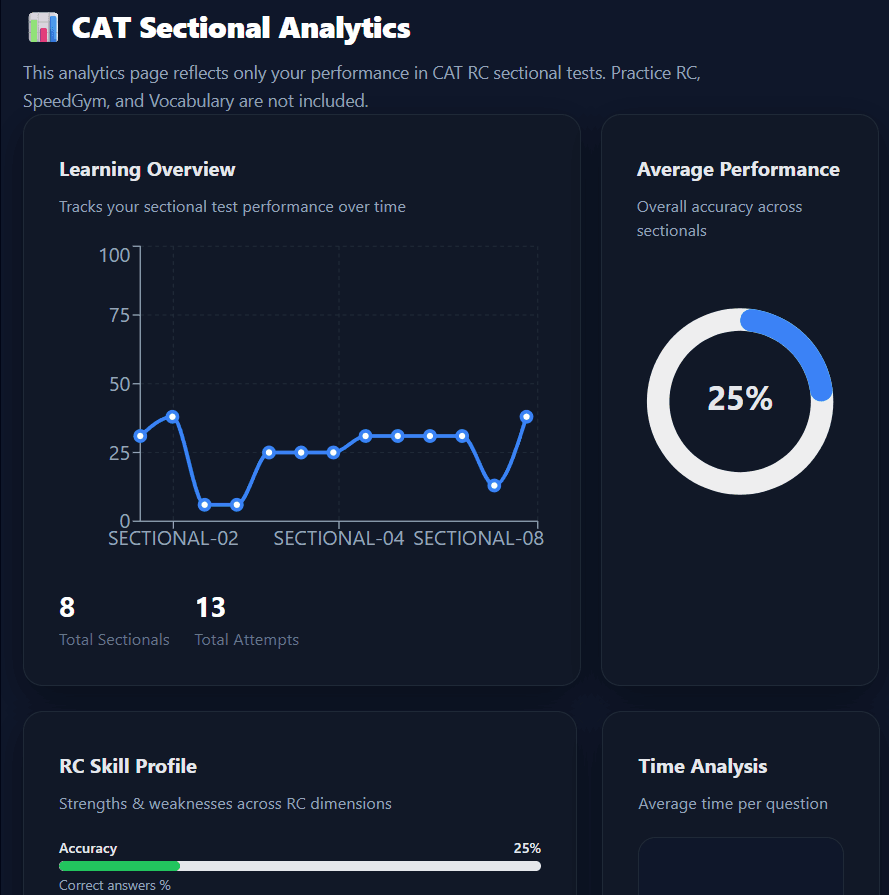
For institutes running Auctor RC under their own name, the same data rolls up into a faculty dashboard, so a teacher can see, across a batch, exactly where students are collectively stuck, and a parent report that shows measurable movement over time, not just attendance.
Built around individual progress
Practice adjusts to the individual student, not a fixed curriculum everyone works through in the same order.
Mistakes get explained, not just marked. A wrong answer comes with the reasoning behind the right one, so the same mistake is less likely to repeat.
Reader DNA surfaces patterns a student usually can't see about their own reading, like the speed-versus-accuracy tradeoff, early enough to correct it before exam day.
Built by a teacher with 15-plus years in competitive exam prep, so the question design and explanations come from real classroom experience, not a generic template.
Covers the full spread of exams that test RC, so a student prepping for more than one exam at once does not need a separate tool for each.
For institutes, the same platform gives faculty a way to show parents concrete improvement numbers, useful for retention conversations that used to rely on attendance alone.
Why Auctor RC is Different
Most RC prep resources fall into two categories: static question banks—a fixed set of passages with an answer key and no adaptation—and generic reading-comprehension apps built for a broad audience rather than for a specific competitive exam.
Auctor RC sits apart on two points. First, the adaptive loop: practice generates data and data adjusts what comes next, which a static PDF or question bank cannot do. Second, the content itself is built by a teacher with 15-plus years actually teaching this section, not adapted from a general reading app or written without classroom teaching experience.
FAQs
Everything you need to know about the platform, practice experience and institute access.
Auctor RC is used to practice and improve the Reading Comprehension section across competitive exams, including CAT, XAT, CLAT, IIFT, SNAP, NMAT, TISSNET, and CUET English.
Auctor Labs, founded by Neeraj sir, a competitive exam teacher with over 15 years of classroom experience.
A question bank gives you passages and an answer key. Auctor RC tracks what you get wrong and why, then adjusts your next practice session around that specific gap, instead of moving through a fixed set in a fixed order.
Birbal is the AI tutor inside Auctor RC. It explains the reasoning behind each RC answer, including why a tempting wrong option is wrong, instead of just marking a question right or wrong.
Reader DNA is a profile of how you actually read, built from your practice data. For example, it can flag that you read fast but lose accuracy, a pattern called an “Impulsive Reader,” so you know exactly what to fix.
CAT, XAT, CLAT, IIFT, SNAP, NMAT, TISSNET, and CUET English.
Auctor RC is ₹399 a month or ₹1,999 for the year.
Yes, Auctor RC offers a free trial period before you need to subscribe.
No. It’s built to work alongside a coaching batch or self-study, not replace a teacher. Institutes also use Auctor RC directly under their own branding, with faculty dashboards to track student progress.
The core Daily Workout is a structured 30-minute session, built so you don’t need to decide what to practice each day.
Both, and specifically how they trade off against each other. Reader DNA is built around the idea that reading faster without checking accuracy is not real improvement, so the platform tracks both together rather than optimizing for speed alone.
Yes. Auctor RC offers a white-labeled version for coaching institutes, with faculty dashboards and parent progress reports.